




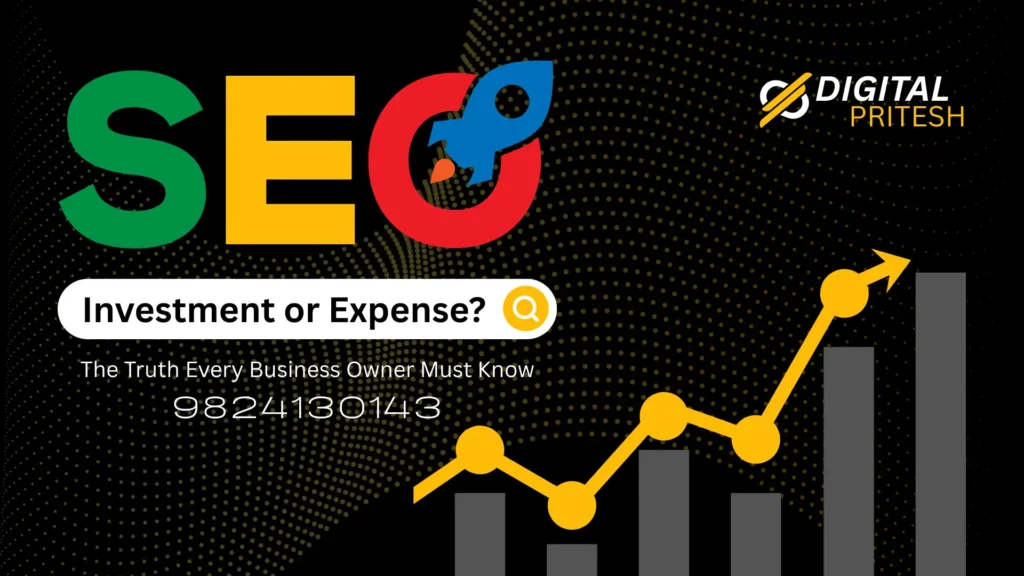
SEO (Search Engine Optimization): An Investment or an Expense?
Introduction
When businesses think about marketing, they often categorize activities into two types: expenses and investments. Expenses are short-term costs with no lasting value, while investments create long-term growth and future returns.
So where does SEO fit?
Search Engine Optimization (SEO) is not just a marketing activity—it is one of the most powerful investments a business can make.
While it does require time, effort, and money, the returns far exceed the initial resources. SEO builds visibility, authority, credibility, organic traffic, and long-term brand equity—none of which disappear overnight.
In this article, we will explore why SEO is a long-term investment, how it works, what returns it delivers, and why treating it as an expense can limit business growth.
What Is SEO?
Search Engine Optimization (SEO) is the process of improving your website so it ranks higher on search engines like Google. It involves:
- Keyword research
- Technical optimization
- Content optimization
- Link building
- User experience improvements
- Brand authority building
SEO helps businesses become visible to customers searching for relevant products or services.
SEO: Expense vs. Investment — What’s the Difference?
An Expense:
- Temporary
- Produces short-term effects
- Must be repeated continuously
- Stops giving results when payment stops
Example: Paid ads.
When ads stop, traffic stops—instantly.
An Investment:
- Long-term
- Generates compounding returns
- Builds lasting value
- Strengthens business assets
Example: SEO.
Even if you pause SEO for a few months, rankings and traffic continue.
SEO Generates Long-Term Organic Traffic
Paid ads give results only while the money flows.
SEO gives results for months or years.
Once your website ranks on the first page:
- You get free traffic
- You get consistent leads
- You get new customers every day
- You don’t pay for every click
This is the definition of an investment with long-term returns.
SEO Builds Brand Authority and Trust
People trust Google’s top results.
When your business appears at the top:
- Customers trust you more
- They view you as an expert
- Your brand becomes memorable
- Your conversions increase
Authority is not built through short-term expenses.
Authority is built through long-term investment.
SEO Increases ROI Over Time
Unlike paid marketing, SEO gets cheaper the longer you do it.
Month 1–3:
You are building foundational SEO (content, technical fixes).
Month 4–6:
Your website starts ranking for keywords.
Month 6–12:
Traffic increases organically, ROI increases dramatically.
SEO investments compound—just like money invested in stocks or real estate.
SEO Brings High-Intent Leads
Someone searching “best salon near me” or “hire software developer” is not casually browsing.
They are ready to buy.
SEO captures customers at the perfect moment—the moment of intent.
That’s why organic search leads are 8x more likely to convert than social media leads.
SEO Reduces Overall Marketing Costs
Businesses that rely only on ads will always have higher marketing costs because ads become more expensive every year.
But SEO:
- Reduces dependency on ads
- Lowers cost per lead over time
- Provides consistent, predictable traffic
This makes SEO a cost-saving investment.
SEO Builds a Long-Term Brand Asset
Your website becomes more powerful with SEO.
- Your domain authority increases
- Your content library grows
- Your keyword footprint expands
- Your brand visibility multiplies
This strengthens your business forever.
SEO Gives Your Business a Competitive Advantage
If your competitors rank higher, they get:
- Your traffic
- Your customers
- Your revenue
SEO helps you outrank competitors and dominate the market.
That’s not an expense—it’s a strategic asset.
SEO Has Compounding Returns
Just like compounding interest in finance, SEO grows exponentially.
Every piece of content you publish:
- Attracts traffic
- Gains backlinks
- Builds authority
- Boosts rankings
Your website keeps growing even while you sleep.
SEO Provides Valuable Customer Insights
SEO lets you understand:
- What customers are searching for
- What problems they have
- Which services are in demand
- Which content converts the best
This data improves:
- Social media strategy
- Ad strategy
- Email marketing
- Product development
You don’t get this kind of insight from expenses—you get it from investment.
SEO Increases Brand Credibility
Most people scroll past ads.
But they trust top organic results.
SEO boosts:
- Brand trust
- Credibility
- Professionalism
- Brand reputation
And trust = higher conversions.
Why Some Businesses Wrongly Treat SEO as an Expense
1. Lack of Awareness
Owners don’t understand how SEO works, so they treat it like advertising.
2. Expecting Instant Results
SEO takes 3–6 months to show strong outcomes.
People used to short-term ads think SEO is slow.
3. Cheap SEO Services
Businesses try cheap providers who deliver nothing.
They assume SEO doesn’t work.
4. No Measurement
Without tracking, SEO seems unclear.
Without KPIs, it feels like an expense.
What Happens When You Treat SEO as an Investment?
Your business will experience:
- More website traffic
- Higher-quality leads
- Higher conversion rates
- More organic revenue
- Better brand reputation
- Lower marketing costs
- Increased long-term profitability
That’s the power of an investment mindset.
Real Examples of ROI from SEO
Salon Business Example
A salon ranking for:
- “best salon near me”
- “bridal makeup”
- “keratin treatment price”
receives 100–1000 organic leads per month.
IT Company Example
Ranking for:
- “software development company USA”
- “hire react developer”
- “web development services”
can generate $50,000–$200,000 in recurring revenue.
Ecommerce Business Example
Ranking product pages doubles revenue without spending more on ads.
SEO Fundamentals That Make It a Powerful Investment
1. High-Quality Content
Blogs, landing pages, SEO articles, and guides bring long-term traffic.
2. On-Page Optimization
Title tags, meta descriptions, headings, keyword placement.
3. Technical SEO
Site speed, mobile optimization, crawlability.
4. Backlink Building
Quality links from trusted websites increase authority.
5. Continuous Optimization
No SEO campaign is ever “complete”—it evolves with algorithms.
The True Value of SEO: Compounding, Scalable, Evergreen Growth
SEO is not like social media posts that disappear in 24 hours.
It’s not like ads that disappear once the money runs out.
- SEO stays.
- SEO grows.
- SEO compounds.
Need help building a long-term SEO strategy?
Let’s connect. or Call +91 98241 30143 or WhatsApp
Conclusion
Search Engine Optimization is absolutely an investment—one of the most powerful, scalable, and long-term investments any business can make. It builds visibility, trust, authority, and a consistent flow of high-intent customers. While it requires time, patience, and consistent effort, the long-term rewards outweigh the initial cost.
Businesses that treat SEO as an investment grow faster, stronger, and more profitably than those that see it as a mere expense.
If you are serious about long-term business growth, SEO is not optional—it’s essential.
for more information read
FAQs
1. Is SEO expensive?
Good SEO is an investment, not a cost. It pays for itself through organic traffic and conversions.
2. How long does SEO take to show results?
Typically 3–6 months, depending on competition and strategy.
3. Why is SEO better than ads?
Ads stop giving results when you stop spending. SEO keeps generating traffic for years.
4. Can any business benefit from SEO?
Yes—salons, IT companies, ecommerce, real estate, healthcare, and even small local shops.
5. What is the biggest advantage of SEO?
Long-term, compounding organic growth that reduces marketing costs permanently.